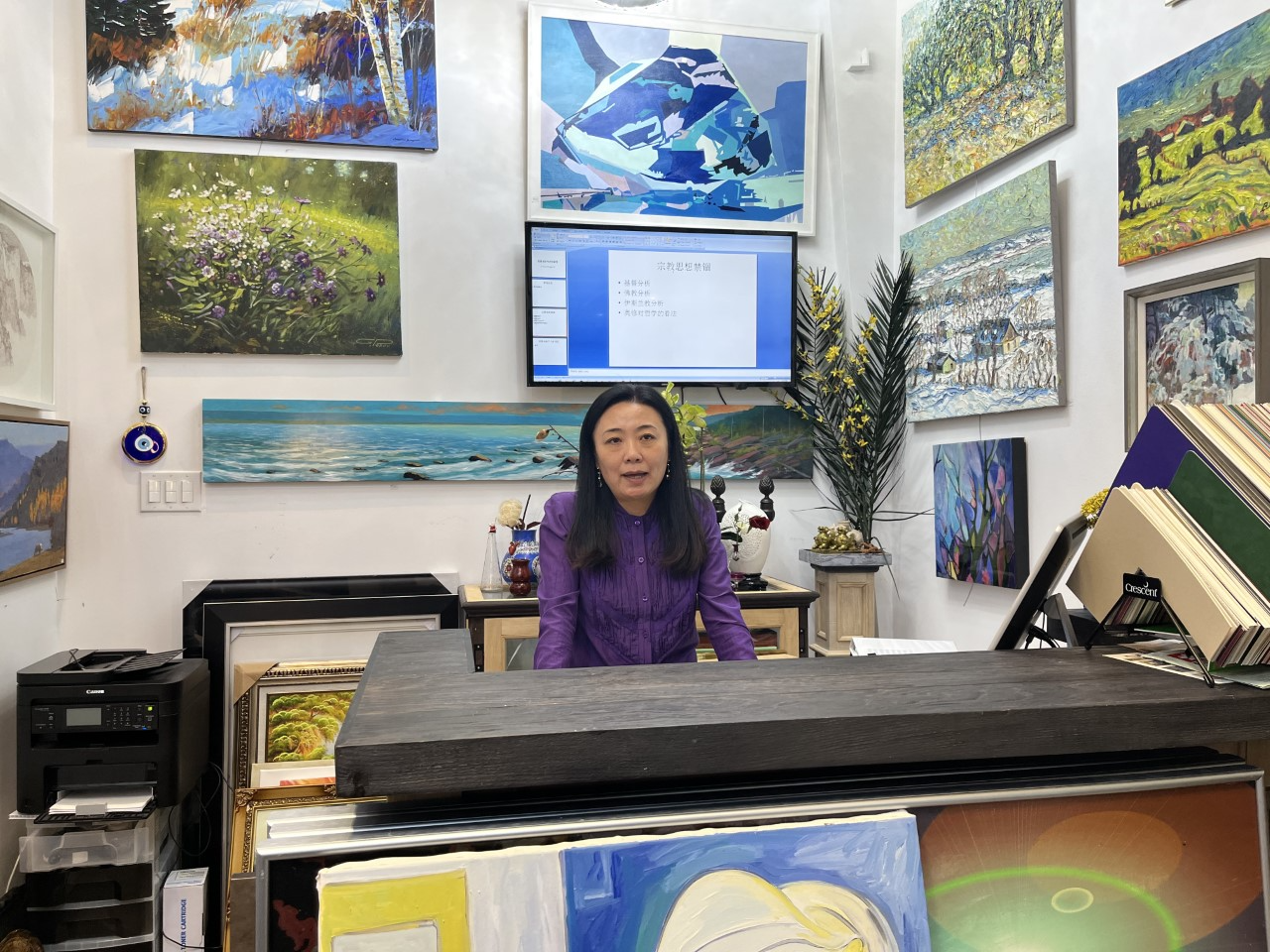
On May 24, 2022, the International Culture Federation (ICF) held its seventh salon event at the M2 Gallery in Improve Canada. The theme of this session was “Active Thinking and Artistic Creation.” The event was hosted by Ms. Maggie Yu and co-sponsored by CYCA and ACPN.
Ms. Yu began the discussion by contrasting active thought with restricted thought. She noted that during the Spring and Autumn and Warring States periods, Chinese society was turbulent, but intellectual life was extraordinarily vibrant. Schools of thought flourished, with philosophers traveling, persuading rulers, promoting their political ideas, or writing influential works. This created a period of unprecedented intellectual prosperity known as the “Hundred Schools of Thought.” Many great politicians, scholars, and thinkers emerged in this transformative age. Their ideas not only shaped Chinese intellectual and cultural history but also gave rise to distinct literary and philosophical schools. However, the core doctrines of Confucianism, Daoism, Mohism, and Legalism later became the theoretical basis for rulers to restrict and control the thoughts of the people.
Typical historical examples of such restrictions include: the burning of books and burying of scholars under Emperor Qin Shi Huang, the Han dynasty’s policy of “rejecting all schools and honoring only Confucianism,” the dominance of Neo-Confucianism under the Song dynasty, and the literary inquisitions of the Qing dynasty. Why did such suppression occur? Ms. Yu explained that it reflected conditions in society, material foundations, class structures, politics, culture, and technological development. Ruling elites feared that new ideas would spark mass intellectual liberation and radical social transformation. Such change could shift class relations, while diverse thinkers expressed conflicting views on societal problems. This weakened royal authority, fostered conflict among feudal lords, and disrupted a unified ideological system. The rise of private schools broke the aristocratic monopoly on education, produced large numbers of intellectuals, and strengthened the scholar class. Greater understanding of and control over nature advanced productivity and commercial prosperity. Using the Song dynasty as an example, Ms. Yu explained how economic development encouraged progress in thought, yet also led rulers to restrict individuality by enforcing Confucian orthodoxy, which suppressed creativity. She also touched on the restrictive influence of religious thought, citing Osho’s reflections on philosophy, and connected this to discussions on children with active minds, sometimes labeled with ADHD, sparking thoughtful debate.
Ms. Yu then outlined the three stages of artistic creation:
-
Artistic Experience – the artist’s perception, observation, and reflection on life, which forms an inner reservoir of impressions and emotions. Artistic inspiration is often an instantaneous intuition, a sudden enlightenment, accompanied by strong emotional and psychological activity.
-
Artistic Conception – based on artistic experience, the artist processes, refines, and organizes life materials into artistic imagery. This involves simplification, exaggeration, deformation, or synthesis, transforming life into artistic truth. This stage is the central link of creation.
-
Artistic Expression – where the artist uses material, artistic language, methods, and skills to transform mature conceptions into works of art. True artistic creation combines ideological depth with artistic expression, and outstanding works always embody both.
This event was co-organized by the ICF executive team together with the Federation’s Artists Club, Wellness Club, Women Entrepreneurs Club, and Daoist Philosophy Club.