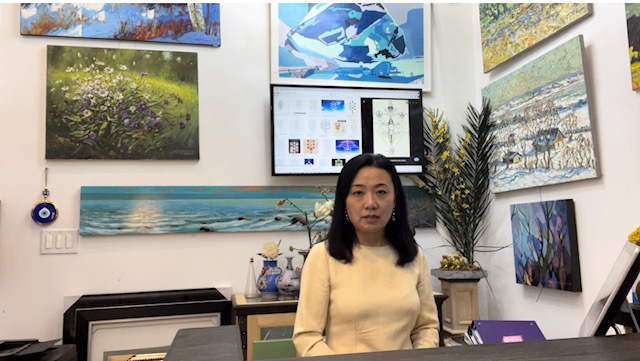
On June 14, 2022, the International Culture Federation (ICF) held its ninth salon event at the M2 Gallery in Improve Canada. The theme of the session was “Speculations on the Sanxingdui Bronze Sacred Tree and the Kabbalah Tree of Life.” The event was hosted by Ms. Maggie Yu and co-sponsored by CYCA and ACPN.
Since the discovery of the Sanxingdui site, the unearthed artifacts have drawn immense curiosity due to their unusual and mysterious shapes. One of the most representative relics is the Bronze “Sacred Tree to Heaven”, which stands 3.96 meters tall today but was likely originally five meters or higher. The tree is divided into three tiers, each with three robust branches, and each branch supports a platform on which a sacred bird perches—each bird crafted vividly as if alive. Experts believe the tree was created more than 3,000 years ago, most likely as a ritual object symbolizing communication between humans and the divine. The birds were thought to pray for good harvests and prosperity, based on the form and imagery of the tree itself.
Ms. Yu introduced the broader phenomenon of the Tree of Life in human root cultures, beginning with the Kabbalistic Tree of Life in Western tradition. Unlike the often allegorical or symbolic expressions in Eastern culture, Western records tend to preserve more detailed structures. By studying the Kabbalah Tree of Life, she suggested, we can better understand our own cultural traditions. The Kabbalah Tree of Life, also called the “Inverted Tree,” originates from Jewish mysticism and is seen as a blueprint of God’s creation of the universe. It is not just a diagram but represents a true three-dimensional cosmic structure. The diagram consists of ten Sephiroth (spheres or emanations) connected by twenty-two paths. Humans begin at Malkuth (the Kingdom) and, through meditation, ascend step by step toward Kether (the Crown). Each sphere is said to be guarded by archangels. The Tree can be divided into three pillars, ten spheres, four worlds, and twenty-two paths. Entry and exit are guarded by angels and demons, symbolizing that one must overcome inner temptations and ultimately achieve transcendence greater than even the angels in order to reach eternal life.
The Sanxingdui Sacred Tree also consists of three tiers—base, trunk, and dragon—with three branches per tier, nine branches in total, each bearing a golden crow, as well as numerous hanging “fruits.” Everywhere in the design we see the numbers three and nine, symbols of nobility and cosmic order in Chinese culture. The number nine, in particular, was associated with imperial authority (“Nine Heavens,” “supreme nine-five dignity”). The number three carried cosmological meaning, with Daoism describing “One gives birth to Two, Two gives birth to Three, and Three gives birth to all things.” Thus, the numerological design of the Sanxingdui tree was almost certainly deliberate, reflecting its role as a ritualistic “ladder to heaven,” rooted in the earth’s center, channeling spiritual energy, and serving as a means to ascend and communicate with the divine. The giant bronze tree vividly embodies the ancient Shu people’s mythic consciousness of unity between heaven and man.
The original Kabbalistic Tree of Life diagram shows a tree with roots pointing upward, symbolizing the descent of divine light into the material world. If inverted and compared with the Sanxingdui Sacred Tree, parallels emerge: both symbolize early human civilizations’ attempts to explain existence and consciousness. Both reflect ways of thinking and proto-scientific imagination rooted in recognition of nature and the cosmos.
Ms. Yu emphasized that by comparing cultures across regions and eras, we can find corroborating patterns. When two seemingly unrelated traditions point to the same core truths beneath different expressions, we should pay attention—this may indicate real universal principles. She also reminded participants that human knowledge is always limited. People tend to reinforce only what they already believe, and language, being linear, cannot fully convey spiritual wholeness. In the modern era of information overload and echo chambers, perspectives fragment further, making communication and cooperation harder. Recognizing and counteracting these barriers is essential for human collaboration and the forward progress of civilization.
This event was jointly organized by the ICF executive team together with the Federation’s Artists Club, Wellness Club, Women Entrepreneurs Club, and Daoist Philosophy Club.